As we are now in the month of January, I thought it fitting that we pay tribute to the Roman god, Janus, after whom this month is named. Janus or more properly Ianus (pronounced 'yanus') was considered by the Romans to have been the first King of Latium. He is thus, the 'beginner' and he begins the year. From Ianus is derived the Latin for door, ianua, leading back to the Proto-Italic *ianu, also meaning 'door', and this in turn is derived from the Proto-Indo-European *ieh₂nu which has the meaning of 'passage'. The English word janitor (Latin: ianitor) derives from ianua.
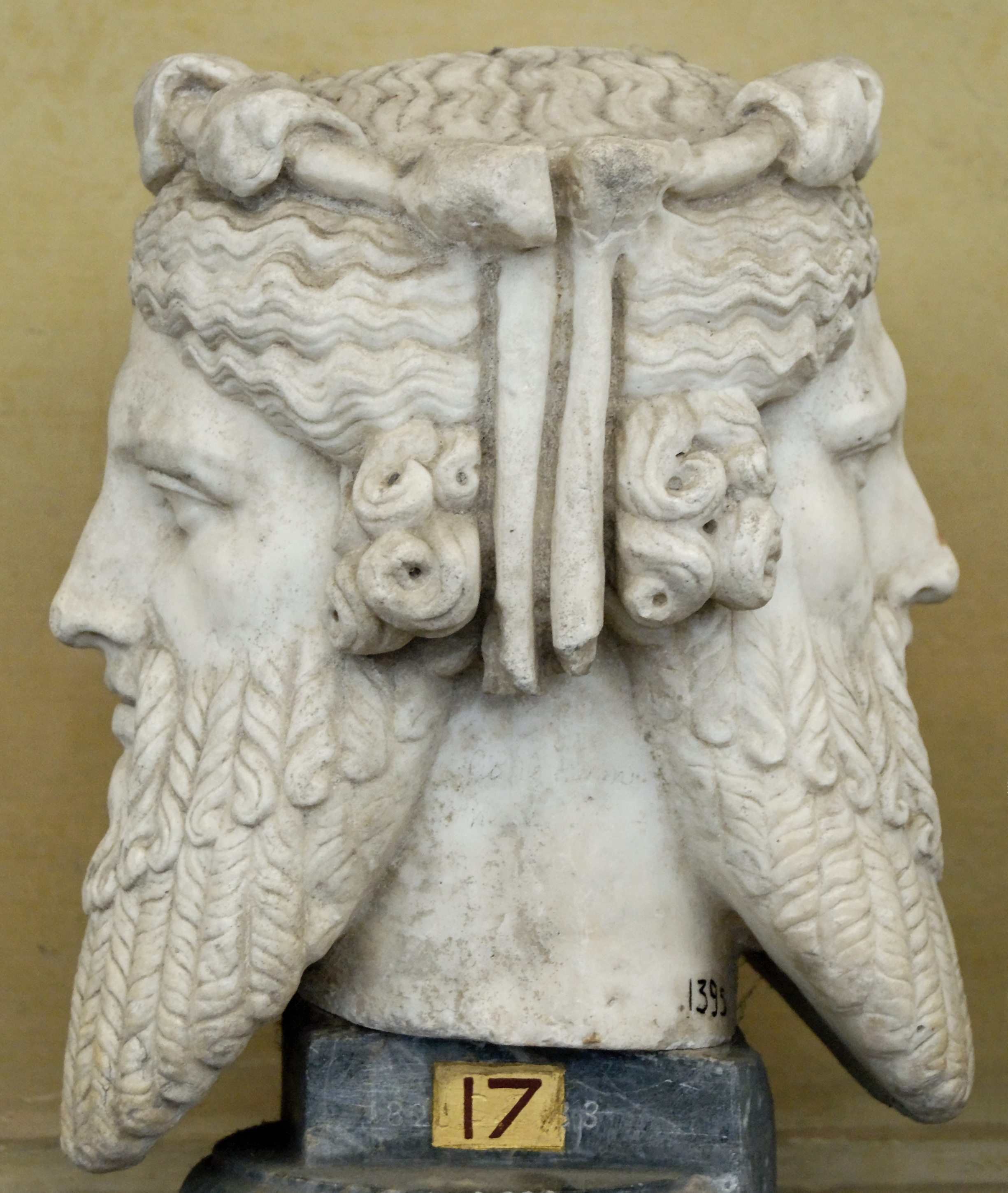
Linked to the idea of beginnings and doorways is the idea of transition or change. January is the beginning of a NEW year, not a repetition of what has happened before, hence the practice of making 'new year resolutions', which reflects the concept of change. Images of Ianus depict him as having two faces, one looking back to the left and one looking forward to the right. Sometimes one face depicts an old man while the other depicts a young one, symbolising the passing of the old year to make way for the new. Typically, the young man is an unbearded youth. He is therefore, a deity of time.
As a god who presides over beginnings, by default he also presides over endings, over death as well as birth and plantings. He is therefore the god who presides over war and peace which is reflected in the customs relating to his temple. The Temple of Janus is said to have been built by the legendary second King of Rome, Numa Pompilius (753-672 BCE), a small temple containing a bronze statue of Ianus and situated in the Roman Forum. The doors of the temple, known as the 'Gates of Ianus' were kept closed during times of peace but left open in times of war. The reasons for this custom are unclear but according to Virgil, it was to hold in Discord and Fury during times of peace, a kind of prison, if you will. The temple was square in shape and was depicted on Roman coins during the reign of Nero (54-68 CE).
Through Ianus, the Romans gained access to other gods in their prayers as he was the gateway to all the gods and should therefore be invoked first. It is interesting though that Ianus had no dedicated priesthood; the rex sacrorum ('king of the sacred things'), a senatorial priesthood of the ruling patrician class undertook his rites; later this was the duty of the pontifex maximus. At the beginning of each ceremony it was Janus whom had to be invoked.
Janus is one of the few Roman deities who has no known Greek equivalent. His exact origins are thus unknown but one train of thought is that they may be found among the Sumerians and Babylonians. The Mesopotamian god, Isimud, an attendant of Enki, is portrayed with two faces in opposite directions. It should be pointed out that despite the visual similarity, Isimud's functions are entirely different to those of Janus. Two-faced and multiple-faced gods are quite common among the Indo-Europeans and one only has to think of Svetovit, Porevit and Triglav!
The custom of invoking Janus at the beginning of all rites, regardless of the deity, is indicative to me that his importance had been far greater in more distant archaic times, possibly ranking alongside Iuppiter (Jupiter) himself. One only has to examine his many epithets to get a sense of that: the Sower, the Opener, the Gatekeeper, and in particular, the Good Creator, King, the Father of the gods, God of the gods: he was no minor deity!

https://commons.wikimedia.org/wiki/File:Double_herm_Chiaramonti_Inv1395.jpg
https://upload.wikimedia.org/wikipedia/commons/3/34/Double_herm_Chiaramonti_Inv1395.jpg
Vatican Museums, CC BY 3.0 <https://creativecommons.org/licenses/by/3.0>, via Wikimedia Commons


No comments:
Post a Comment