Thursday, 25 December 2025

dies natalis Solis Invicti

 Today is the birthday of the sun, to give his Roman name, Sol Invictus (pronounces sol inwictus), the Invincible Sun, the origin of the commercial festival which many of you are today celebrating in ignorance as 'Christmas Day'. Here in the northern hemisphere, the day of the winter solstice falls on either the 21st or 22nd December but nevertheless it has been celebrated on the 25th here in England since Anglo-Saxon times. 

Yule, the Germanic pre-Christian term for 'Christmas', still used today, is also the time which marks the halfway point of winter if we consider that the autumn equinox is that point which marks the beginning of the decline of the sun's powers: we call this 'midwinter'.

According to the Venerable Bede (672/673-735 CE) of Jarrow, in the old, historic county of Durham, the pre-Christian Anglo-Saxons called December and January Yule or Giuli to give it its Old English name. It marked the turning of the year and he discusses this in his de temporum ratione (On the Reckoning of Time). The Anglo-Saxons used a ten month lunar calendar as did the Romans until 46 BCE when Julius Caesar reformed the Roman calendar into a lunar-solar one consisting of twelve months. The observant reader will see traces of the old Roman calendar in the modern English names for the months: September (septem=seven), October (octo=eight), November (novem=nine) and December (decem=ten).

Later, the Anglo-Saxons differentiated between the first half of Yule (December) by calling it Ǣrra-ġēolamōnaþ and the second half, Æfterra-ġēolamōnaþ (January). The Old Norse equivalent of Geōla being Jól. Bede also attested to another feast that was held at this time of the year, Mōdraniht, meaning 'night of the mothers'. From the original Latin:

                            'incipiebant autem annum ab octavo Calendarum Januariarum die, ubi nunc natale Domini celebramus. et ipsam noctem nunc nobis sacrosanctam, tunc gentili vocabulo Modranicht, id est, matrum noctem appellabant: ob causam et suspicamur ceremoniarum, quas in ea pervigiles agebant.''

My translation:

'They began the year from the eighth calends of January, when we celebrate the birth of the Lord. And that same night now sacred to us, they used to call by the pagan name Modranicht,that is, the night of the mothers: for the reason, we suspect, of the ceremonies which they enacted on that night.'

The 'eighth calends of January' equates to the 25th December. The 'mothers' referred to by Bede are likely to have been the very same personages known to us as the disir in Old Norse, the itis in Old High German, the idis in Old Saxon and the Old English ides. The similar etymology for these terms across four old Germanic languages seems to imply a common and ancient Germanic cultural and religious inheritance. Taking the Old Norse term, dis, we find this as a suffix in Vanadis, the dis of the Vanir, an epithet for the goddess, Freyja. This would imply that the mothers, if they are indeed disir are divine or semi-divine entities, possibly ancestrices of the Anglo-Saxons themselves, elevated to a semi-divine status by a people who honoured their distant ancestors to the point of reverence and worship.

 Indeed, there may very well be a connection between the disir and the 'mothers' via the matronae/matres worshipped by the Celto-Germanic peoples of northwest Europe. Stone altars attesting to their worship are to be found in Gaul, the Rhineland and the low countries, particularly in areas occupied by the Romans. The best known of these deities is without a doubt, Nehalennia attested to in 2nd and 3rd century BCE Gallia Belgica (Belgic Gaul), a Romano-Celto-Germanic cultural melting pot. Anyone interested in Nehalennia and similar deities would benefit from obtaining a copy of Nehalennia. Divine Lady of Prosperity, Trade and Safe Crossings by Gunivortus Goos (GardenStone), 2023.

The idisi are referred to in the First Merseburg Charm, written in Old High German and dated to the 9th century. 

                                              Eiris sazun idisi,

                                              sazun hera duoder;
                                              suma hapt heptidun,
                                              suma heri lezidun,
                                              suma clubodun
                                              umbi cuoniouuidi:
                                              insprinc haptbandun,

                                              inuar uigandun (Griffiths, 2003)


Modern English translation (by Giangrosso, 2016)

                                              Once sat women,

                                              They sat here, then there.
                                              Some fastened bonds,
                                              Some impeded an army,
                                              Some unraveled fetters:

                                              Escape the bonds,
                                              flee the enemy!

The idisi are clearly not mortal women when one analyses their activities, which resemble more that of the Nornir, referred to in the Eddas, who decide the fates of men.

Monday, 22 December 2025

Why Do Bible Scholars Still Peddle the Myth that Jesus Ever Existed?

 Despite the lack of evidence for the historical existence of 'Jesus of Nazareth', the majority of academics who earn their daily bread from the study of this fictional/mythical character still cling tenaciously to their childhood beliefs in the the 'man from Galilee', even if they no longer hold to alleged miracles attributed to him. Why is this? Why do they maintain that the 'Jesus' of history is a 'proven fact' when there is not an iota of evidence to support this 'fact'? Not a single piece of historical evidence that is CONTEMPORANEOUS to the alleged lifetime of 'Jesus' can be uncovered. 

Scholars are fond of telling us that there is ample evidence for the life of 'Jesus' from secular and Roman sources but the fact of the matter is, no such evidence exists: all references were made by authors who were not even alive during 'his' lifetime. How then can the writings of authors such as Josephus, Tacitus et al be considered 'evidence' when they are at most mere hearsay and thus in a court of law, INADMISSABLE! 

Some of my readers (I trust only some) would argue that Jesus, being an insignificant first century Jew would not have been newsworthy enough to be mentioned by Roman sources, and yet this man is supposed to have caused a stir in Galilee and Jerusalem: healing the sick, the lame, the blind, the deaf, raising the dead to life, casting out thousands of demons, feeding 5,000 people with just five loaves of bread and two fishes (housewives please take note!), walking on water, turning water into wine, creating enemies among the Jewish priestly cast and finally coming to the attention of the Roman authorities and dying by crucifixion, causing a solar eclipse, an earthquake, with many tombs opening up and the dead raising again to life, then Jesus resurrecting after three days and ascending into the clouds. How could this man, if he existed, be not newsworthy enough for the Romans, who avidly reported on and recorded the least little thing? You would have thought that a dead man walking around for forty days would have come to the attention of somebody significant! 

Or did none of these things ever happen? And if they never happened, why should we also believe that the man who allegedly caused these things to happen (but didn't) ever exist? I am sure that Jesus (Yeshua) was a very popular name at that time in Judaea and Galilee so I am positive that someone with that name did exist but that is not the same thing as arguing that THE Jesus of Nazareth was an historical figure, and if you divest his life from all the alleged supernatural activity then what are we left with other than a first century Jewish proto-hippy? Is that enough to build a religion on? Is that enough to torture and kill those who do not accept this religion? 

If the Jesus of 'history' did not exist then everything else about Christianity is false. We must bear in mind that the majority of  Bible scholars are Christians, often evangelical and American. Those that are not tend to start off in life as students of theology, not history and not a few would have attended some kind of seminary for Christian ministry. Rejecting the Jesus of the miracles is one thing but rejecting the very existence of the man would be a step too far for many of them, especially when we have passages like this in the New Testament:

                                             'For many deceivers are entered into the world,

                                             who confess not that Jesus Christ is come in

                                             the flesh. This is a deceiver and an antichrist.'

                                             (2 John 1:7, KJV)

So, even in the days when John's second epistle was written towards the end of the first century there were already people who doubted or denied his historical existence! Yet, those scholars who cling to the theory of an historical Jesus would have us believe that this is a comparatively recent theory, id est, the 'mythical Christ' theory. If doubt about an historical Jesus has risen only in 'recent' times (18th century onwards) then perhaps this has more to do with the weakening of the Church's grip upon the populations whom they serve, not simply a 'new' and 'anti-authoritarian' stance? The Church can no longer keep us in ignorance and they can no longer enforce their theology and practices on the rest of us! 

If Christianity were any other religion it would be rightly referred to as a cult or a mythology but in certain parts of the world, most notably in North America, it still wields enormous influence and can help to determine the outcomes of elections. Christianity is especially politicised in the United States, where childhood indoctrination and Christian fairytales don't fade away so easily. Scholars in any discipline are extremely cautious and conservative by nature and tend to fear straying too far from the 'received view', and in the case of Bible scholars, to doubt the historicity of Jesus, in the United States in particular, would be akin to falling upon one's own sword. It takes an extremely courageous man to go against mainstream and 'received' opinion in religion or in anything else for that matter.

Friday, 19 December 2025

Reflections on Yule Part Four-The 'Virgin Birth' and its Pagan Antecedents

 Having already established in my earlier essay Reflections on Yule Part Two-The Lie of Jesus's Existence that there is no evidence for an historical 'Jesus of Nazareth', I must turn to the the nonsense written by the writers of the gospels concerning his alleged 'virgin birth'. It would be helpful at this point to cite the main scriptural references which cover this 'miraculous' event.


18 Now the birth of Jesus Christ was on this wise: When as his mother Mary was espoused to Joseph, before they came together, she was found with child of the Holy Ghost.

19 Then Joseph her husband, being a just man, and not willing to make her a public example, was minded to put her away privily.

20 But while he thought on these things, behold, the angel of the Lord appeared unto him in a dream, saying, Joseph, thou son of David, fear not to take unto thee Mary thy wife: for that which is conceived in her is of the Holy Ghost.

21 And she shall bring forth a son, and thou shalt call his name Jesus: for he shall save his people from their sins.

22 Now all this was done, that it might be fulfilled which was spoken of the Lord by the prophet, saying,

23 Behold, a virgin shall be with child, and shall bring forth a son, and they shall call his name Emmanuel, which being interpreted is, God with us.

24 Then Joseph being raised from sleep did as the angel of the Lord had bidden him, and took unto him his wife:

25 And knew her not till she had brought forth her firstborn son: and he called his name Jesus.

(Matthew 1:18-25, KJV)

26 And in the sixth month the angel Gabriel was sent from God unto a city of Galilee, named Nazareth,

27 To a virgin espoused to a man whose name was Joseph, of the house of David; and the virgin's name was Mary.

28 And the angel came in unto her, and said, Hail, thou that art highly favoured, the Lord is with thee: blessed art thou among women.

29 And when she saw him, she was troubled at his saying, and cast in her mind what manner of salutation this should be.

30 And the angel said unto her, Fear not, Mary: for thou hast found favour with God.

31 And, behold, thou shalt conceive in thy womb, and bring forth a son, and shalt call his name Jesus.

32 He shall be great, and shall be called the Son of the Highest: and the Lord God shall give unto him the throne of his father David:

33 And he shall reign over the house of Jacob for ever; and of his kingdom there shall be no end.

(Luke 1:26-33, KJV)

Interestingly, the so-called 'virgin birth' is not referred to in the other synoptic gospel, Mark. The term synoptic is used for the first three gospels as they have a similar style and structure, narrating events like a story. The gospel of John is radically different in style and content, appearing to be influenced by Gnosticism. It is the only canonical gospel which refers to Christ as the logos and is certainly worthy of study. Considering that the gospel of Mark is older than Luke, it does appear strange that the writer should omit to relate the story of Jesus's divine and virgin birth. Could this be because this was a developing idea which only gradually came to be established to bolster the idea that Jesus was the 'son of God', and not part of the earliest narrative, that Mark also predates Matthew (an ongoing debate among Bible scholars). 

The virgin birth account of Matthew and Luke are supposed to be a fulfillment of an Old Testament prophecy:

14 Therefore the Lord himself shall give you a sign; Behold, a virgin shall conceive, and bear a son, and shall call his name Immanuel. (Isaiah 7:14, KJV)

The term 'virgin' is a translation (or mistranslation) of the Hebrew almah , which has the usual meaning of 'young woman' and need not imply that the girl is virgo intacta! Anyone familiar with the mythologies of the ancient world, both Semitic and Indo-European would recognise instantly that the 'virgin birth' of Jesus is simply a common trope of a semi-divine god-man. Examples of such god-men include:

Perseus, son of Zeus (pronounced correctly like the Latin deus)  and the woman, Danae.

Attis, son of an almond discarded by the gods and the woman, Nana who was also of divine or semi-divine birth, being the daughter of the Phrygian river-god, Sangarius, who was himself the son of Oceanus.

Ra, the son of the goddess, Neith and the product of parthenogenesis, which is an asexual form of reproduction where the egg requires no fertilisation.

Zoroaster, the son of the virgin, Dughdova and a shaft of light.

Alexander the Great, born of the mortal woman, Olympias of Epirus and the god, Zeus in the form of a serpent.

Romulus and Remus, sons of the mortal woman, Rhea Silvia and the god, Mars.

Asclepius, the son of the mortal woman, Coronis and the god, Apollo.

Helen of Troy, daughter of the mortal woman, Leda and the god, Zeus.

Krishna, the son of the mortal woman, Devaki and the god, Vishnu.

There are many other such examples in the pre-Christian and non-Christian world of demi-gods being born from the union of a god/goddess with a woman/man, whether this be a virgin birth or any other type of miraculous birth. Thus, the alleged 'virgin birth' of Jesus of Nazareth has very clear pagan antecedents.

Sunday, 14 December 2025

Reflections on Yule Part Three-the Heathen Elements of Christmas

 Having established in my earlier essay Reflections on Yule Part One-the Lie of Christmas (the Dating) that 'Jesus of Nazareth' was not born on 25th December and the lack of historical evidence for his existence in Reflections on Yule Part Two-the Lie of Jesus's Existence , I turn now to the clear pre-Christian and heathen elements of the festival which Christians refer to as 'Christmas' (Christ Mass).

Father Christmas/Santa Claus/St. Nicholas

This character is so clearly heathen in character that the Church does not even attempt to hide his true origins, except in trying (and failing) to give him a 'Christian' name: St. Nicholas, a 'saint' that was remarkable for his generosity and gift giving. His name evolved into 'Santa Claus' through the Dutch 'Sinterklaas'. The parallels between this character and the continental Germanic Wodan are clear. I refer my readers to an old essay of mine: Santa Claus and his Origins in Germanic Folklore .

The Exchange of Gifts

This practice can be traced to the pre-Christian Roman festival of Saturnalia when statuettes made from wax or clay were given as gifts. Often they took the form of images of the gods. Of course, Christians will try to explain away this custom as being related to the giving of gifts from the three wise men to the child Jesus. During Roman times gift giving became more and more extravagant and opulent, very much like the commercialism of Christmas today.

The Singing of Carols

The word 'carol' stems from the Old French carole, which was a circle dance, accompanied by singing. Although people today always seem to associate the term with Christmas, that was not always the case. Of course, not all Christmas carols have a religious flavour to them: many are now very secular and seasonal popular songs, and this has been the case since the1950s at least. The origin of singing carols at Christmas more than likely has its origins in pre-Christian Yule as part of the seasonal practice of chasing away the 'evil' of winter to make way for the birth of the sun. The ancient custom of wassailing in England appears to be one of the precursors of this custom where singers went from door to door offering a drink from the wassail bowl (a goblet) in exchange for a gift. Door to door carol singing is an extension of this custom. 

Christmas Candles

The lighting of Advent candles is not very common in modern England (except in churches) but it is a ubiquitous custom in Germany. Christians attribute the lighting of special and often decorative candles as symbolic of the 'light of Christ' entering the world. The truth of the matter is, prior to the invention of electric lighting, candles were one of the few means of creating artificial light during the dark winter evenings. I have already mentioned the giving of wax gifts at Saturnalia and this helps to explain the phenomenon of the Christmas candle in this age of electricity!  

The Christmas Tree

The decoration of an evergreen conifer in winter has clearly nothing to do with the fable of a Jewish child born in a middle-eastern stable! The decoration of such trees is clearly a custom which originated in the cold Germanic north. Why our ancestors decorated such trees is anyone's guess. Some may suggest that it is a half remembered custom from the days when the heathen Germanic peoples of continental Germania engaged in the veneration of trees, the Irminsul obviously springs to mind. The custom of decorating small conifers did not take hold in England until the 19th century, when Queen Victoria imported the custom from her native Germany.

Christmas Wreaths

This form of greenery is closely associated with the Christmas tree, evergreen which survives the winter and is largely used as a seasonal decoration on front doors here in England. Like the Christmas tree, this is a German import and one which I have only seen popularised in recent years. With its import into England its artificial 'Christian' significance has been entirely lost. The modern Christmas wreath dates back to 16th century Lutheran Germany. The wreath in Germany is not hung on a door but is studded with candles to mark the four weeks leading up to Christmas. No doubt, the Lutherans cobbled together this practice from the Roman feast of Saturnalia and Yule, the elements going to make up the wreaths are clearly heathen in nature and origin.

The Yule Log

Due to the lack of coal fires and the rise of central heating in England, this is a custom which has virtually died out. A log is selected and portions of it burnt on the hearth fire during this season until the twelfth night. It seems to have served as a bringer of good luck and a protective device against lightning and fire. The burning of the Yule Log symbolised the return of the sun, with the light and heat that it carries with it. The customs, practices, beliefs and superstitions varied by country and region but there is no doubt that they all had a common origin in pre-Christian religion and indeed may stretch right back to Proto-Indo-European times. The remnants of this custom are now to be found in the rather pathetic 'Yule Log' cake, which hardly anybody associates with the original concept.

Holly

Decorating rooms with holly can be traced back to the Roman feast of Saturnalia. Its survival through the harsh northern winter again is symbolic of the eternal reappearance of the sun at this time of year. It also has protective qualities. The redness of the berries signify the continuity of life when all around appears to be lifeless.

Ivy

Always associated with the holly is ivy, symbolic of death. In ancient carols ivy, was depicted as being female and forlorn while holly was male and full of life. Together they symbolise the eternal struggle between life and death, summer and winter. The ancient Romans believed that ivy was a device to help prevent drunkenness, and the god Bacchus is pictured as wearing a wreath on his head! 

Mistletoe

Like holly, this plant also fruited during the winter season and was a symbol of fertility. In ancient times the druids harvested this plant from oak trees. Its white berries were symbols of male virility. It is likely that the druids, however used the plant for medicinal purposes. The plant is said to offer protection from witches and evil spirits.

Excessive eating and drunkenness

Little needs to be said about this and I have yet to encounter a Christian who can establish a case for these being  'Christian' activities. These are clearly a remnant of the feast of Saturnalia.


Friday, 12 December 2025

Reflections on Yule Part Two-The Lie of Jesus's Existence

 Having established in my previous essay Reflections on Yule Part One-The Lie of Christmas (the Dating) that Jesus of Nazareth was not born on 25th December, I am now going to present my arguments for his non-existence in the historical record. Bear in mind that if he never existed then there could have been no birth, no death and no 'resurrection'!

When debating with Christians online regarding the existence of Jesus of Nazareth, I tend to encounter identical arguments, almost as if they have read the same instruction manual and quote the same 'evidence' parrot-fashion. The most annoying thing is that they assume that I have never researched the issue and then label me as 'arrogant' when I said that I have done so over many years and can find no evidence. When I ask them to provide me with some evidence they either do not reply or they say that 'there is more evidence for the existence of Jesus than Julius Caesar' (correctly pronounced as yulius kaiser). This of course is untrue but it is a falsehood that appears to be quite popular among unthinking and uncritical believers. There is an abundance of evidence to support the fact that Julius Caesar was a real and an historical figure. 

Unlike Jesus of Nazareth, Caesar was a writer, and his accounts on the Gallic wars he was involved in, are discussed in detail in his commentarii de bello Gallico (Commentaries on the Gallic War), which in itself is primary and contemporaneous evidence of his existence. Caesar was an accomplished poet as a young man and his work was quoted by other Roman authors, although the poems themselves are now lost. We know the names of two of them: laudes Herculis (Praises of Hercules) and a verse tragedy, Oedipus. He was also mentioned in the letters and speeches of the Roman statesman, Cicero (Marcus Tullius Cicero) and the Roman historian and politician, Sallust (Gaius Sallustius Crispus).

There is also numismatic evidence for his existence; Caesar was the very first living Roman politician to have his portrait placed upon coins, namely silver denarii, struck in 44 BCE. He commissioned the building of monuments bearing his name, the most famous example being the Forum Iulium, which contained the Temple of Venus Genetrix (templum Veneris Genetricis), which emphasises Caesar's claimed descent from the goddess. After Caesar's brutal murder he was cremated and his ashes placed in the Temple of Divus Iulius (Aedes Divi Iulii).

Now how does the evidence, if any for Jesus of Nazareth compare to that of the divine Julius? Unlike Caesar, Jesus left behind no writings of any kind. His purported sayings in the canonical gospels (Matthew, Mark, Luke and John) are not first hand accounts and are alleged to have been authored between 65-100 CE. Given that Jesus is supposed to have been crucified between 30-33 CE, these gospel narratives cannot be said to be firsthand or primary accounts: they are secondary accounts and thus hearsay. Additionally, they are not secular accounts and thus not impartial. As such, the gospels would not stand up to scrutiny in a court of law!    

Not only did Jesus not leave behind any writings but his name does not appear in any contemporaneous historical records. Believers will seek to explain this lack due to him being 'not very well known' and yet according to the gospel accounts he created quite a stir in Jerusalem and Judah, and terrestrial and celestial phenomena were supposed to have occurred at the time of his death, and yet not a whimper was raised in the otherwise meticulous records of the Roman scribes! If he did exist then he clearly was not considered to be important enough to warrant just one mention in the records, which makes the gospel accounts to be a lie!

At this point the believer will object and say, 'surely he was mentioned by the Roman historian, Tacitus?' There are two problems with that: firstly Tacitus was not alive during the alleged lifetime of Jesus (Tacitus lived from 56 CE to 120 CE) and thus anything he has to say on the matter is pure hearsay and not primary and contemporaneous evidence, but also he does not refer to a Jesus of Nazareth but a 'Christus' in his Annals. Christians and other apologists for the historical Jesus narrative tend to present Tacitus's reference as their strongest piece of 'evidence'. To be fair to them I will quote the relevant passage in full:

                                Consequently, to get rid of the report, Nero fastened the guilt

                                and  inflicted the most exquisite tortures on a class hated for

                                their abominations, called Christians by the populace.

                                Christus, from whom the name had its origin, suffered

                                the extreme penalty during the reign of Tiberius at the

                                hands of one of our procurators, Pontius Pilate, and a most

                                mischievous superstition, thus checked for the moment,

                                again broke out not only in Judaea, the first source of the evil,

                                but even in Rome, where all things hideous and shameful

                                from every part of the world find their centre and become 

                               popular.' (Annals 15:44)  

What we need to focus on here first is the identity of the one called 'Christus', then everything else should become clear to my readers. It has been common knowledge among biblical scholars since 1902 that the term 'Christians' in the Annals is an alteration of 'Chrestians' in the earliest extant copy of the Annals in Florence. The letter 'i' had been clearly altered by a scribe from an 'e'. Is this a supposed later 'correction' of an earlier scribal error or a deliberate act of deception by a Christian scribe? Does the change of vowel make any difference? Before I answer this question I would like to turn to another Roman source which Christians point to as 'evidence' for their Jesus of Nazareth.

Suetonius (Gaius Suetonius Tranquillus), a Roman historian who lived from about 69 CE to after 122 CE refers to the expulsion of Jews from Rome by Claudius at sometime during the period 41-53 CE in his Lives of the Twelve Caesars (de vita Caesarum)  and refers to a 'Chresto'. The actual Latin text is as follows:

                             Iudaeos impulsore Chresto assidue tumultuantis Roma expulit.

My translation: He expelled the Jews from Rome who were constantly making disturbances at the instigation of Chrestus.

The use of the term 'Chresto' by Suetonius accords with the term 'Chrestians' used by Tacitus to designate the followers of this man. It should be noted that 'Chresto' is the ablative case of 'Chrestus'. There is nothing in this quotation to suggest that 'Chrestus' equals Jesus Christ or Jesus of Nazareth. Jerusalem at this time was a hotbed of preachers, healers, false 'messiahs' and other assorted crackpots and as Tacitus mentioned, alternative ideas, philosophies and religions all gravitated towards Rome, just as they did in California in the 1960s and 70s: nothing new here! If we take Suetonius literally, then how could 'Chrestus' instigate his followers to create disturbances decades after his alleged death?

What if any is the difference in meaning between 'Chrestus' and 'Christus'? 'Christus' is the Latin translation of the Greek 'Khristos', meaning 'anointed one' and its Latin form is very rare outside of Christian circles. By comparison, 'Chrestus' from the Greek 'Khrestos' simply has the meaning of 'good' and bears no equivalency with 'Christus'/'Khristos'. Interestingly, 'Chrestos' was quite a common name at that time (particularly of freed slaves) and could have been carried by any anti-Roman rabble-rouser! Just because the two names seem similar is not a good enough reason to suppose that they relate to the same man or that man is Jesus of Nazareth but this is the very week defence put forward by generally pro-Christian Bible scholars (who as academics should know better) and believers.

In the mystery religions of the ancient world the term 'Khrestos' was used for an initiate undergoing trials prior to achieving enlightenment. In pre-Christian gnostic sects, 'Khrestos' was the term given to a suffering disciple seeking purification prior to enlightenment, while 'Christus' signified the one who had achieved enlightenment or perfection, having successfully passed through all his trials. They are thus, degrees of initiation and were in usage long before the birth of Christianity. They do not therefore, have to point to an historical person.

Another popular source for believers are the writings of the Jewish historian and Roman general, Flavius Josephus (born Yosef ben Mattityahu) about 37 to 100 CE. As with Tacitus and Suetonius, Josephus wasn't even alive during the alleged lifetime of Jesus of Nazareth so anything that he has to say must be regarded as hearsay but he is the closest in time to the life of Jesus. There are two references to 'Jesus' in his Histories of the Jews (antiquitates Iudaicae), written in 94 CE in a passage now referred to as the testimonium Flavianum (the Testimony of Flavius). He is unequivocally referred to in Book XVIII, chapter 3. However, they are now believed to be later interpolations made by Christian scribes. According to Professor Paul Hopper, the use of Greek verbs forms are distinctly different in the 'Jesus' passages compared to the rest of the text and that the passage is 'close in style and content to the creeds that were composed two to three centuries after Josephus.' The professor's conclusion was that 'the entire passage is interpolated.' (See 'A Narrative Anomaly in Josephus: Jewish Antiquities xviii: 63', 2014). So much for Josephus and the less said about that, the better!

What has Pliny the Younger (Gaius Plinius Caecilius Secundus, 61-about 113 CE) to say about Jesus of Nazareth? Strictly speaking, NOTHING. He does, however refer to the Christian sect and their god, Christ in his letter to Trajan, written around the year 112 CE. By equating Christ with a god who is worshipped is evidence of a rapidly developing theology but in itself is not evidence for an historical Jesus. Like the other classical writers, Pliny the Younger is not contemporaneous with the lifetime of the alleged Jesus. 

                                  they were accustomed to meet on a fixed day before

                                 dawn and sing responsively a hymn to Christ as a 

                                 god, (Letter to Trajan) 

All of the abovementioned writers represent the 'key' secular sources for the evidence in favour of an historical Jesus, and not a single one of the writers were alive during the alleged lifetime of 'Jesus of Nazareth'. How strange also that writers who were alive during his alleged lifetime such as Pliny the Elder (Gaius Plinius Secundus), 23/24-79 CE), Seneca the Younger (Lucius Anaeus Seneca), 4 BCE-65 CE and Philo of Alexandra (Philo Judaeus), about 20 BCE-about 50 CE never wrote a single jot about him!


Wednesday, 10 December 2025

Reflections on Yule Part One-The Lie of Christmas (the Dating)


https://commons.wikimedia.org/wiki/File:Stele_Sol_Invictus_Terme.jpg

https://upload.wikimedia.org/wikipedia/commons/c/ca/Stele_Sol_Invictus_Terme.jpg

Baths of Diocletian, Public domain, via Wikimedia Commons


This series of essays originated as a reaction to the recent and sudden emergence of 'Christian Nationalism' in the United Kingdom, which is yet another unwanted and unasked for import from that loony bin of religious nutters, the United States. 'Tommy Robinson's' recent public promotion of Christianity is causing a third nationalist force or movement to arise in this country: 'Christian Nationalism', which as I have argued in my earlier essay, The Dangers of 'Christian Nationalism' Arising in the United Kingdom is a relatively new nationalist movement and 'Robinson' is one of its key architects. The other two nationalist movements being Civic Nationalism and Ethnic Nationalism or Ethno-nationalism.

'Christian Nationalism' is not only a nationalist movement in its own right but has the potential to unite the other two factions, Ethnic Nationalism and Civic Nationalism. If this is allowed to happen then it would exert a powerful influence upon any future government of a 'nationalist' sentiment, such as a potential government led by Reform Uk Ltd. We have seen how 'Christian Nationalism' has, during Trump's two terms in office, exerted an influence upon policies flowing from the 'Oval Office'. If this were to happen in this country, one can envisage how 'Christian Nationalism' may quickly shed its snakeskin and transform into a fully ledged 'Christofascist' movement. Once given temporal power, the Church, as in the past, misuses this power for its own ends. In such a society, anyone with diverging political and religious views may face a certain amount of persecution.  

Having established my reason for starting this series of essays, I must now move on to discuss how the Church gradually transformed the ancient pre-Christian feast of Yule by superimposing an artificial Christian veneer. Let us start with the date of 'Christmas', 25th December. As anyone who has ever read the gospel accounts in the New Testament can affirm, there is no evidence in those accounts of the 'birth' of 'Jesus' to substantiate such a date, and to be fair, the vast majority of Christians, both real and imaginary ('Christian Nationalists') would readily agree with that. So what is the significance, if any, of that date? Quite simply, in the Roman Empire, the 25th December was commemorated as the day of the 'birth of the sun', being the winter solstice in the Roman calendar. The calendar of Antiochus of Athens, a notable Greek astrologer, who lived between the late first and the mid second century CE marks that date as the 'birthday of the Sun'. From 274 CE, the Roman festival of dies natalis Solis Invictus (the day of birth of the invincible sun) was held on 25th December. Please note that Latin words should never be capitalised, even at the beginning of a sentence, the only exception being that of proper nouns, and Sol Invictus is a proper noun. The emperor, Aurelian (Lucius Domitius Aurelianus), c. 214-275 CE, revived the cult of the sun god, and raised Sol Invictus to being the primary god of the empire.

Now the question may be asked, did the tradition of celebrating Christ's 'birthday' precede the dating of dies natalis Solis Invictus? There is no evidence that it did: the earliest evidence for the dating of the 'birthday' of 'Jesus' is the Filocalian Calendar, produced in 354 CE for a wealthy Roman citizen, Valentinus by Furius Dionysius Filocalus, an illustrator, mapmaker, scribe and stone engraver, who became the official engraver of Pope Damasus (304-384 CE). Of course, one may legitimately argue that 'lack of evidence is not evidence of absence' and they would be perfectly correct, but as the primary texts of Christianity, namely the gospels, do not specify a date, and given that the winter solstice was already an established festival in Europe, known in the Germanic lands as Yule, then it would be equally legitimate to argue that this date was chosen by the Church in order to provide a Christian veneer to a clearly pagan festival. The symbolism of the birth of the infant sun and its growing light in a dark world would not have been lost on the likes of Augustine in the fourth century CE, who commented on this in his sermons. Conveniently for the Church, the winter solstice festival is a nice and neat nine months from the date of the spring equinox in the Roman calendar, 25th March and known as the 'Annunciation', the conception of the Christ child by the 'virgin' Mary.   

Islam, an Abrahamic religion which also acknowledges 'Jesus' as a prophet, contends that his birth occurred sometime between June and October, giving plenty of scope for the Jesus freaks to make their argument that he could have been born in any of one of six months: plenty to choose from! Of all the various Christian sects, only the Jehovah's Witnesses have, in my opinion, the correct view. They view 'Christmas' as a later addition by the Church, pointing out that the earliest Christians did not celebrate his birth and that the concept originated in the fourth century CE, using the Roman feast of Saturnalia as its template. The feast of Saturnalia, as the name suggests, was held in honour of the Roman god, Saturn. It was celebrated on 17th December according to the Julian calendar. The Julian calendar was a solar one, proposed by Gaius Julius Caesar in 46 BCE, replacing an earlier lunisolar one. This remained the predominant calendar in the western hemisphere until the introduction of the Gregorian calendar, introduced by Pope Gregory XIII in 1582 CE.  The Jehovah's Witnesses argue that as the shepherds would have been unlikely to be out in the fields in December, they propose that early October would have been a more logical time.

Sol Invictus is not the only god to be 'born' on 25th December: he is accompanied by a host of other deities who share the same birthday: Horus, Osiris, Attis, Zoroaster, Heracles, Mithra, Krishna, the Buddha, Tammuz, Adonis, Bacchus, Hermes, Prometheus and Dionysus. My sincerest apologies to any deities whom I may have inadvertently omitted to mention! 

Saturday, 15 November 2025

The Dangers of 'Christian Nationalism' Arising in the United Kingdom

 My readers will note that I have placed 'Christian Nationalism' in inverted commas, the simple reason being is that this ideology is an oxymoron, a contradiction in terms, as anyone familiar with the New Testament knows:

                              "There is neither Jew, nor Greek, there is neither bond, nor free,

                                there is neither male nor female: for ye are all one in Christ

                                Jesus." (Galatians 3:28, KJV)     

The aforementioned quotation is an echo of sorts of the words of the fictional and mythological construct, 'Jesus':

                                "But he willing to justify himself, said unto Jesus, And who 

                                 is my neighbour?" (Luke 10: 29, KJV)       


After relating the parable of the 'Good Samaritan', 'Jesus' made it clear to the man that all whom he encounters should be viewed as his 'neighbour'. This thinking is at sharp contrast with those who espouse the nonsensical ideology of 'Christian Nationalism', which like all bad ideas is an import from the United States. As an aside, my late mother, a practising spiritualist predicted the rise of 'Christian Nationalism' and its spread from the United States to the United Kingdom. Bearing in mind that she died in 1989, this is an incredible prediction which has since come true.

In recent months, I have seen the rise of new channels and old channels on Youtube dedicated to spreading 'Christian Nationalist' propaganda, always without exception, linked to anti-Islamic sentiment and mass immigration. There is nothing particularly new in this as this drivel began to be spouted by the British National Party in the early 2,000s. Realising that directly attacking mass immigration on racial grounds was legally problematic and not conducive to electoral support, they swiftly began to take up the banner of 'Christian Nationalism', although they did not, as far as I remember, use that expression. They attacked Islam while hiding behind the banner of a fake Christianity. With the demise of the BNP, this strategy was taken up by the Britain First Party, who would often parade on the streets behind a large wooden cross. There is nothing remotely 'Christian' about the politics of these two parties. As we have seen, this became a failed strategy at the time and helped neither party electorally.

With the rise of Reform UK Ltd and its little sister, Advance UK, and bearing in mind the rising popularity of both organisations, it seems pertinent to me to examine their stated stance on the issue of Christianity and its relationship to the United Kingdom. I shall start with Advance UK first as their statement is unambiguous:

                                         "The Party promotes and celebrates the Nation's

                                           Christian constitution, roots, traditions, culture,

                                           and values."  (https://www.advanceuk.org.uk/mission 

                                           accessed on 12/11/25).

Note the use of the verb 'promote'! Interestingly, its current leader is a businessman, Benyamin Naeem Habib, a British citizen of Pakistani Muslim paternal heritage. (https://www.youtube.com/watch?v=pbXBX4c8_Wg ) . His mother was an English Anglican and Habib himself is not a Muslim. I am not sure what the relevance of Advance UK is apart from its potential to split the Reform UK Ltd vote! 

The real worry comes from Reform UK Ltd. Very wisely, they have decided not to mention their stance on Christianity in any of their policy documents ( Reform UK Policy Documents ). Therefore, in order to ascertain their position on the subject of religion, we must delve far deeper. One Reform councillor has reportedly told Northumberland County Council 'that children should only be taught Christianity in Religious Education because exposure to other religions might 'brainwash' them.' (Quote taken from the website of Humanists UK https://humanists.uk/2025/09/17/reform-councillor-demands-christian-only-re-to-end-brainwashing/ See also the story reported online in the Northumberland Gazette: https://www.northumberlandgazette.co.uk/news/politics/council/reform-councillor-in-northumberland-claims-studying-non-christian-religion-could-brainwash-children-5317274

Of course this is only one councillor and does not necessarily reflect the official views of the party to which he belongs. One Reform UK Ltd parliamentary candidate acknowledged on Premier Plus radio that 'many Reform supporters see the party as aligned with Christian principles.' ( https://www.premier.plus/inspirational-breakfast-with-esther-higham/audio-series/clips/audio-items/is-reform-uk-representing-christian-values )

I am not aware that Nigel Farage, the leader of Reform UK Ltd has made any overt statements on the subject of religion but he has not entirely ignored the subject either. Declaring at a speech in Blackpool in 2024, he reportedly said that 'Judeo-Christian values' are at the root of everything in 'Britain.' Speaking at the Alliance for Responsible Citizenship this year he reportedly stated: "We've kind of forgotten that what underpins everything is our Judeo-Christian culture and that's where we need to start ." ( https://www.issacharpeople.org/Articles/715854/How_Christian_is.aspx ) It should be remembered that the Chairman of Reform UK Ltd, Zia Yusuf is himself a Muslim. The influence of affluent Muslims in Reform UK Ltd causes me to question how deep these supposedly 'Christian' sentiments go. To me it sounds like political opportunism, playing to a particular demographic but in politics perception is everything  and there is an increasing perception that the policies of that party align with the hopes and aspirations of Christian voters.

Another rising star to watch is the new leader of the 'one trick pony' UKIP, Nick Marcel Tenconi who is also the Chief Operating Officer of the right-wing Turning Point UK which in itself is an offshoot of Turning Point USA, a conservative students pressure group which advocates capitalism and reactionary politics. According to the website novaramedia.com Tenconi describes himself as a 'Defender of masculinity, Christianity and conservative values.'

One rather unusual character who is starting to make waves in the 'Christian Nationalist' movement is self-styled 'Bishop' Ceirion Dewar, age 49. I can find no public record of his ordination as a priest or his consecration as a bishop in the Anglican church. It is thus unclear as to how and from whom he derives his consecration but he is not recognised by the Church of England.  He is, however, listed on the 'Confessing Anglican Church' website. See https://confessinganglican.church/cac-bishop-cei-dewar-leads-prayer-at-uk-rally/ What is particularly important here is the fact that he opened the 'Tommy Robinson' 'Unite the Kingdom' rally. Mr Dewar does not identify himself as a 'Christian Nationalist' but he is certainly associated with people who are.

 Unlike the United States, up until now, religion has never been an element in British politics but is this about to change? Anti-Islamist campaigner, 'Tommy Robinson', who is an Irish and British citizen of Irish parentage appears to have recently jumped onto the 'Christian Nationalist' bandwagon, whose 'Unite the Kingdom' march in September was marked by his supporters wearing crusader outfits, carrying life-size crosses, banners with biblical verses and Union flags featuring a crucified Jesus. Mixed in with all this fake religiosity were the usual anti-Islam and anti-Starmer pejoratives. Knuckle-dragging civic nationalism has now been given a fake Christian veneer. Last month he went on a much publicised pilgrimage to the 'holy land'. 'Robinson's support for Zionism is a matter of public record and the number of times that he has declared himself a Zionist are too many to mention in this short article. Now he appears to be combining this new found 'love of da lord' with his active support for Israel, his opposition to Islam and making connections between various nationalist groups across Europe. Indeed, he has only just returned from Poland after attending nationalist events to mark Polish Independence Day.

The demographic which all of the aforementioned parties and movements draw active and/or vocal support from (according to my interactions with them) appear to be poorly educated, working class (blue collar worker), middle aged, white men who have an inborn prejudice against the 'other' and a resentment towards all organs of the state, id est the government, (sometimes) the royal family, the police, the judiciary, local authorities and the civil service, with the exception of the military which they appear to unthinkingly worship and whom they regard as being beyond criticism or judicial accountability. This reflects a militaristic attitude among many native English members of the aforesaid demographic. Due to the lack of critical thinking skills and poor education of much of this demographic, they are ripe for reactionary indoctrination.

If this is an indicator of the rise of militant Christianity in the United Kingdom then this is not good news for anyone who resists that religion, regardless of whether they be a humanist, a member of a different Abrahamic religion, a less illiberal form of Christianity or a heathen such as myself. There may be a spiritual thirst among the less cynical English people but that thirst cannot be quenched by an intolerant and alien religion, imposed upon our ancestors by force and deceit and maintained that way for centuries. In summing up, a resurgent and militant Christianity should be as much of a concern to us as militant Islamism!

Sunday, 9 November 2025

The Goseck Circle

 There is a surprising amount of ignorance regarding aspects of the Neolithic and Bronze Age material and spiritual cultures of the German-speaking lands in the Anglophone world. I believe that this is largely due to a lack of  knowledge of the German tongue in these lands: most of the relevant literature is only or mainly available in German rather than English.

There is a thematic connection between this article and my previous one The Nebra Sky Disc-Unetice Culture Part 1  : I would encourage my readers to also read that article. The Goseck Circle predates the Nebra Sky Disc by more than 3,300 years, rooting it firmly in the Neolithic culture of central Europe, not the Unetice culture, which belongs to the central European Bronze Age. However, the distance between these two sites (Nebra and Goseck) is only 25 miles and both are situated in the modern German Land (state) of Sachsen-Anhalt.

Constructed around 4,900 BCE, the circle remained in use until 4,700 BCE, making this the oldest known circle in Europe, older than the first phase of Stonehenge by 1,800 years! I would ask the question, how many people in the United Kingdom or other parts of the English-speaking world are aware of that fact? This is one of the reasons why I started this blog and my previous ones 19 years ago, to bring to light that which is hidden. I have been described by one person as a 'spiritual archaeologist' and this term fits my role exactly!

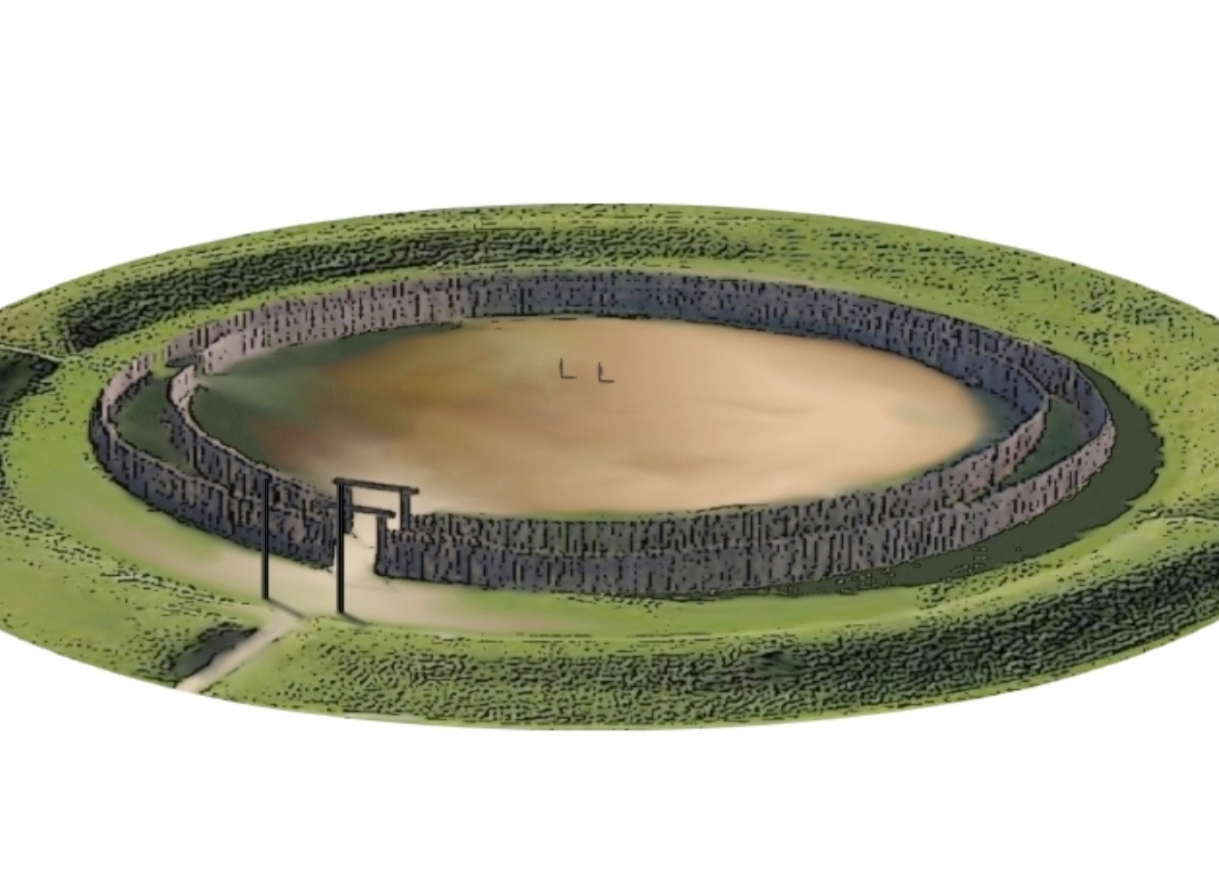
The Goseck circle was discovered in 1991 due to the result of an aerial field survey. This resulted in a major excavation of the site between 2002 and 2005. Following the reconstruction of the wooden palisade, it was opened to the general public in December of 2005. 1,675 oak poles were shaped using hand tools, measuring 8.2 ft in height for each one.

Unlike the better known circles or henges, Goseck was not constructed of stone but of two wooden palisade rings which contain entrances in alignment with the sunrise and sunset of the winter solstice. The southeast gate is aligned with the winter solstice sunrise, the southwest gate with the winter solstice sunset and there is a third gate which points to the true north. Surrounding these wooden palisades was a ditch with the following dimensions: 82 yards in diameter, 2.2 to 3.3 yards in width and a depth of 1.6 to 2.2 yards. It is clear from the dimensions of the ditch that it was ritualistic, not defensive in nature.

It is interesting that while Stonhenge focuses on the summer solstice, the Goseck circle's main focus is that of the winter solstice. However, there are two narrower entrances located between the main gates which are aligned with the summer solstice and these are far less prominent architecturally. Location of the narrower entrances: one between the southeast and northern gates, aligned to the summer solstice sunrise, and one between the southwest and northern gates, aligned to the summer solstice sunset. The two narrower gates appear to have been constructed during the initial building phase. While this neolithic solar observatory marks both solstices, it is interesting why there should be an emphasis on the winter solstice.

The age of the circle as revealed through radiocarbon dating establishes the 4,900 BCE date of the site's construction while the style of the pottery shards establish a presumed last use date of 4,700 BCE. The pottery was the product of the Stroke-ornmented ware culture which flourished between 4,900 to 4,400 BCE or the Danubian Ib culture of V. Gordon Childe which marked the beginning of agrarian society in central Europe. The fact that this was a settled agricultural community explains the emphasis on the winter rather than on the summer solstice. The knowledge of the dating of the winter solstice was a crucial element in the planning of the agricultural cycle. Connected to this scientific knowledge was the religious symbolism of the rebirth of the sun and the rituals associated with that. Winters in that part of the world would have been quite harsh, and thus the expectation of the return of the sun would have held much greater significance spiritually and psychologically than in southern Europe.

There is no evidence of permanent human habitation at the site but human remains have been found there, such as a headless skeleton buried near the southeastern gate, which aligns with the winter solstice sunrise and thus of ritual significance. Other human bones have been found within pits, buried within the circular ditch system. Bovine skulls, dog skulls, goat horns and other animal bones have been found along with multiple burn marks and fire pits, all suggestive of ritual sacrifice. Solar worship was obviously a key element of the Goseck Circle.

It would appear that the abandonment of the Goseck Circle coincided with a transitional phase in neolithic culture, the replacement of the Linear Pottery culture with the Stroke-ornamented ware culture. Whether this change in pottery style was indicative of migration and population replacement, I cannot determine. With a change in material culture there is often a change in that of ritual and belief but it would appear than any such change had been gradual at Goseck and that their beliefs as a continuous population simply evolved.

As with the Nebra Sky Disc, the Goseck Circle is evidence of an advanced central European solar knowledge, and with that knowledge, it is inconceivable to me that there was not a priesthood to safeguard and transmit it!

https://commons.wikimedia.org/wiki/File:Goseck_Circle_1.jpg

https://upload.wikimedia.org/wikipedia/commons/b/bb/Goseck_Circle_1.jpg

Kenny Arne Lang Antonsen, CC BY-SA 4.0 <https://creativecommons.org/licenses/by-sa/4.0>, via Wikimedia Commons

[[File:Goseck Circle 1.jpg|thumb|512px|alt=Goseck Circle, Germany, 4900 BC|Goseck Circle, Germany, 4900 BC. Photo by Kenny Arne Lang Antonsen, CC BY-SA 4.0 via Wikimedia Commons]]

Wednesday, 29 October 2025

The Nebra Sky Disc-Unetice Culture Part 1


https://commons.wikimedia.org/wiki/File:Nebra_disc_1.jpg  

https://upload.wikimedia.org/wikipedia/commons/e/e9/Nebra_disc_1.jpg 

Frank Vincentz, Public domain, via Wikimedia Commons

[[File:Nebra disc 1.jpg|thumb|512px|alt=Nebra Sky Disk|Nebra Sky Disk. Photo by Frank Vincentz, Public domain, via Wikimedia Commons]]


The Nebra Sky Disc or to give it its German name, die Himmelscheibe von Nebra was discovered by two treasure hunters, equipped with a metal detector in 1999 near the town of Nebra in Sachsen-Anhalt (Saxony-Anhalt) in Germany. Although their actions were judged to be illegal we must be grateful for their discovery which unearthed some incredible finds. The discovery came to light in 2002 due to a police operation when the treasure had for the second time been placed on the black market. The find led qualified state archaeologists to start their own dig. It is unfortunate that the treasure hunters damaged part of the disc with a spade and destroyed parts of the site. The find was part of a prehistoric site, enclosing an 827ft high  hill called the Mittelberg. Also unearthed at the site were the remains of two bronze axes, two bronze swords a bronze chisel and fragments of bronze armbands.

 Radiocarbon dating of the sword hilts gives a date of 1600-1560 BCE for the hoard. Likewise, an analysis of the corrosion and metal radioactivity on the disc support this date range. X-ray fluorescence indicates that the copper in the bronze originated from Bischofshofen in Austria; the tin and gold originated from Cornwall. This demonstrates that there were extensive trade links between this area of Germany with Austria and England over 3,500 years ago.

The disc measures approximately 32cm in diameter and weighs 4.9lb. The blue-green patina on the bronze disc is thought to have been created by the smearing of rotten eggs. The colour represents the night-sky and helps to contrast with the gold symbols on the surface of the disc. The symbols contained on the disc include a depiction of the sun, a lunar crescent, stars and two arcs (there were originally three). The stars which are symbolised by 32 gold dots include a cluster of seven stars which are believed to represent the Pleiades. The gold used to make the arcs appears to come from a different source and these symbols are considered to be a later addition.

Around the edge of the disc were originally 38 to 40 holes punched. Researcher, Howard Crowhurst speculates in his book, The Nebra Sky Disc. Cycles in the Cosmos (second edition, 2023) that the actual number is 39. Scientists cannot say with any certainty whether the number is 38, 39 or 40 due to some damage to the edge of the disc. Mr Crowhurst advances several reasons as to why he believes the number to be 39, based on his knowledge of geometry and archaeoastronomy, citing examples from the Mayan calendar and the cycles of the Moon, Mars and Venus as well as the human gestation period. I recommend that my readers purchase a copy of his book. It contains only 76 pages but it is vital reading if you are interested in finding out about the disc. Be aware that it contains a lot of geometry which I found quite difficult to follow: several readings of the book would be necessary for most people to fully understand and consolidate all the information.

Originally, there were two arcs on the left and right sides of the disc but only the right side one has survived. The two arcs have an angle span of 82 deg which show the angle between the positions of the two solstices from the line of latitude of the Mittelberg. This demonstrates to me that the disc was an integral part of the archaeological culture of that area for it has been clearly calibrated for this specific region. 

Mr Crowhurst speculates that the 39 3mm diameter punched holes on the edge of the disc were intended for the insertion of small pegs for the purpose of keeping track of the cycles, making this disc a very practical tool for calculating and synchronising the solar and lunar calendars. In other words, this is a portable version of the likes of megalithic structures such as Stonehenge and Carnac. The science appears to be the same. This is surely evidence for a professional priesthood in the early European Bronze Age?

The god arc at the bottom of the disc is more problematic when it comes to interpreting its symbolism and practical function. Like the other two arcs it is known that this was a later addition to the ensemble of symbols. One rule of thought is that the arc represents the solar boat which is a feature of Indo-European mythology and symbolism found in Latvian, Greek and Hindu mythology and on many Scandinavian petroglyphs (see Chariot of the Sun and Other Rites and Symbols of the Northern Bronze Age by Peter Gelling and Hilda Ellis Davidson, 1969). The archaeologist, Mary Cahill (2015) draws a link between solar boat symbolism and the gold lunulae of the Bell Beaker culture. The subject of solar boat symbolism deserves an article specifically devoted to it which I intend to pen in the not too distant future.

The Nebra site is 25 miles northeast from the Goseck neolithic circle (also in Sachsen-Anhalt) which dates back to 4900BCE. I will discuss this circle in a future article. The disc is part of the Aunjetitzer or Unetice culture which is of particular interest to me personally, being genetically related to thirteen burials from this culture at Leubingen, Thüringen (Thuringia) from 1950BCE. Again, I may discuss these burials in a future article.

Saturday, 4 October 2025

Brigantia, the Tutelary Deity of the Brigantes

 As many of my readers will be aware, the tribe known as the Brigantes was a major Britonnic tribal confederation located in the northern part of England, between the rivers Tyne and Humber, which corresponds to the ancient Anglian kingdom of Northumbria. The Brigantes were also resident in Ireland in the modern counties of Wexford, Waterford and Kilkenny, and on the continent in the Alps. Their capital in England was named Isurium Brigantum (modern day Aldborough, near Boroughbridge in the old West Riding part of present day 'North Yorkshire'). Isurium is taken from the Latin name for the River Ure, the Iseur.

The Devil's Arrows standing stones are located on the outskirts of Boroughbridge. This is one of the many places I lived at with my parents as a boy but my birth town is Darlington, County Durham, which is on the Durham bank of the river Tees, a border town between Durham and Yorkshire. As an aside, I have genetic evidence of being descended from the Brigantes and I have always had a strong affinity with the Devil's Arrows stones.

The name Brigantes shares the same Proto-Celtic root as the goddess, known as Brigantia, meaning 'high, elevated'. This may refer to physical human height, topographical height or metaphorical height. The Germanic Burgundi share a related term and both probably relate back to the Proto-Indo-European *bhergh.

Famously or infamously, the Brigantes were known to be allies of Rome. The defeated anti-Roman resistance leader, Caratacus, the chieftain of the Catuvellauni tribe, was betrayed to the Romans by Cartimandua, the queen of the Brigantes in 51 CE. This heinous act of betrayal strengthened her influence with the Romans. Her degenerate moral character was further demonstrated by the divorcing of her rightful husband, Venutius and her taking of his armour bearer, Vellocatus to be her consort. Despite attempts by Venutius in waging war against her, the Romans defended their client queen with military support, keeping her in power.

It is not known whether the goddess Brigantia was named after the Brigantes, or the Brigantes named after Brigantia. There is evidence for the cult of Brigantia in Gaul, Britain and possibly in Ireland (Brigid). The Romans identified Brigantia with their own goddess, Minerva, who was likewise a goddess associated with warfare and also with Victoria, the divine personification of victory. 

John Moss, writing in his The Celtic Tribes. Origins, Ancestry and the Warrior Class, 2024 hypothesises that she is the same deity as the goddess, Britannia but offers no explanation for his theory. I am not convinced that they are one and the same beyond a slight similarity with their names and the fact that they are both tutelary deities. Britannia is purely a divine personification of the British Isles and may be linked to the Hitto-Phoenician goddess Barat or Brihat who features on Lycaonian and Carthaginian coins, according to Professor L.A. Waddell in his Phoenician Origins of Britons, Scots and Anglo-Saxons Discovered by Phoenician and Sumerian Coins, 1924. See: Britannia, Aryan Tutelary Goddess of the British Isles

A bronze statue in fragments, dating back to the first century CE and housed in the Museum of Britanny is believed to depict Brigantia in her Roman aspect of Minerva. A head and shoulders image is shown below, and one can see the superficial resemblance to Britannia as depicted on pre-decimal British coins.


Museum of Brittany, Public domain, via Wikimedia Commons

https://commons.wikimedia.org/wiki/File:BrigitteCelt.jpg

https://upload.wikimedia.org/wikipedia/commons/1/1c/BrigitteCelt.jpg

Below is an image of a pre-decimal British penny, which ceased to be legal tender on 1 September 1971. The last pennies for general circulation were minted in 1967, although souvenir pennies were also struck in 1970. One can see the image of Britannia on the reverse of the penny.


https://commons.wikimedia.org/wiki/File:British_pre-decimal_penny_1967_reverse.png

Wednesday, 17 September 2025

Wotans Krieger's Code of Aryan Ethics


Edmund Leighton, Public domain, via Wikimedia Commons


 This code, which I have lived by since the age of at least 7 has served me well and I have not included any points which I have not personally adhered to as to do otherwise would be an act of hypocrisy, an unAryan trait.

Do not hate a man because of his race, ethnicity or nationality.

Judge the value of a man solely by his actions.

Do all in your power to preserve the racial integrity of your bloodline.

It is better for one's bloodline to die out than that it should be compromised.

Fulfil all oaths to gods and men.

To break an oath is an act of the greatest dishonour but do not be bound by oaths to men who have first broken their oath to you. Even if it is to your own personal cost or disadvantage, never break an oath!

Do not dishonour your gods in word or deed.

The gods will hold you to account for any dishonourable words or deeds towards them.

Be gracious in defeat and merciful in victory.

Be prepared to offer the hand of friendship to a defeated enemy.

Be prepared to defend your honour by word or deed.

Ultimately satisfaction may be required by fighting a duel.

Defend the weak against tyranny and injustice.

Speak out and act against all wrong doing.

Honour the land and remember that you do not own it: it owns you.

Treat the earth with reverence for She is our Mother.

Do not pollute land, sea or sky.

Just as the earth is our Mother, the sky is our Father.

Respect all wildlife and vegetation.

Life forms that are different from us are still sacred and the gods will hold us to account for our misuse of animal, vegetable or mineral.

Honour our sacred sites, whether megalith, sacred oak, mound, hill, well or grove.

By doing so we maintain a connection to our ancestors and their memory.

Defend your land but do not participate in an unjust war.

Judge the merits of a conflict before risking life and limb and remember that most wars are initiated to maintain or extend the interests of an elite, not the common man. Our distant ancestors only fought if they felt that it was in their own interest to do so. 


Edmund Leighton, Public domain, via Wikimedia Commons